
Clause Gap Alert on Contract Award
GovComply scans every FAR and DFARS clause on contract award and flags documentation gaps within minutes, mapped to acquisition.gov requirements.
Clause Gap Alert on Contract Award
Know exactly what's required before work begins — in minutes, not days.
When a compliance officer onboards a new cost-plus contract today, they manually read the PDF, cross-reference acquisition.gov, and build a spreadsheet of obligations. That takes 2 to 5 days and is error-prone by nature. GovComply eliminates that sprint.
Upload the contract. The AI parses every FAR and DFARS clause, maps each one to its acquisition.gov compliance object, and flags gaps against your current documentation — including severity levels and plain-language remediation guidance. The full analysis runs in under 5 minutes.
What you get
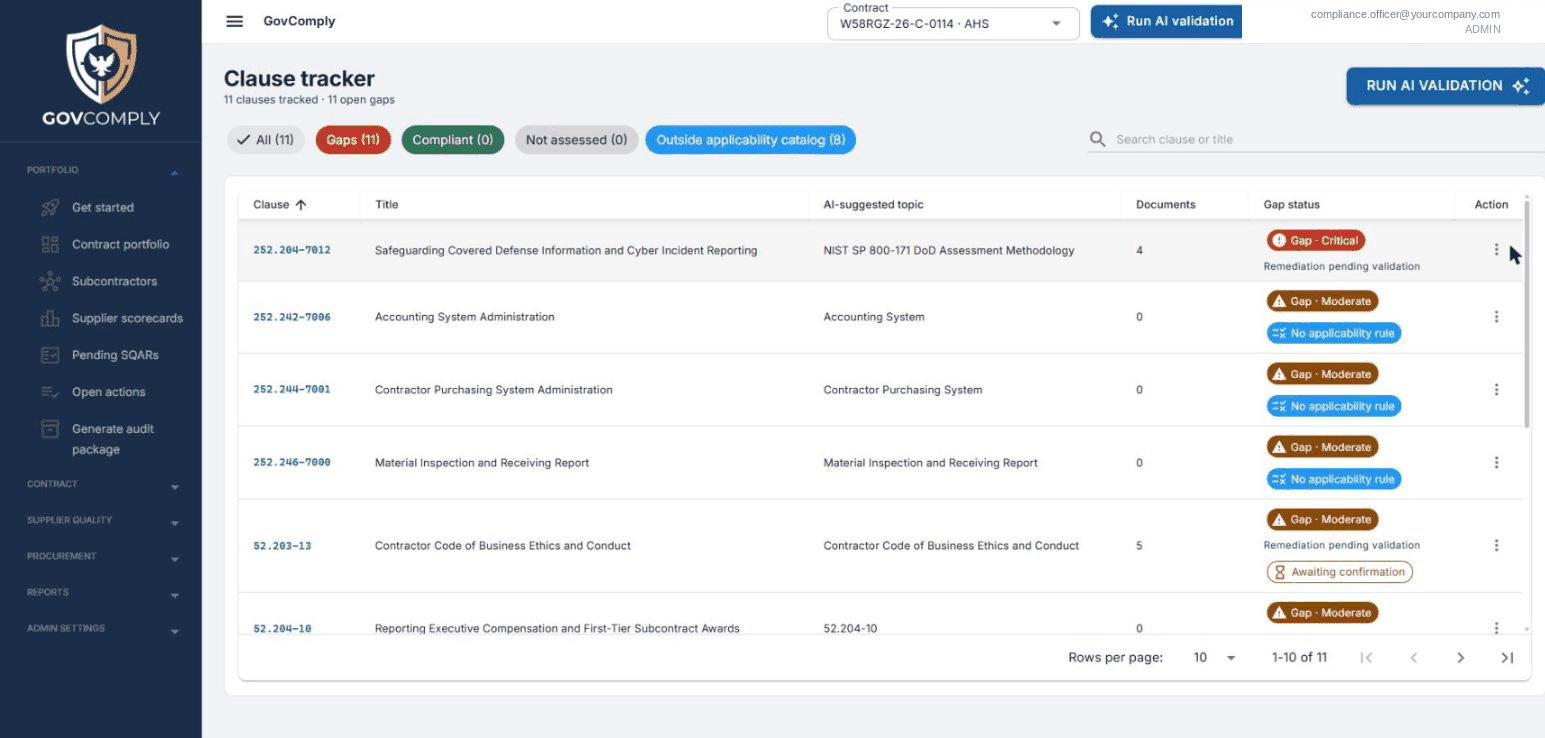
Clause tracker on an awarded Army contract. Every FAR and DFARS clause found in the document is listed with the compliance topic it maps to, the number of documents linked against it, and its gap severity. Clauses the applicability catalog does not yet cover are called out rather than silently skipped.
Live screenshot from the GovComply application. Tenant identifiers, account holder details and third-party supplier document names have been anonymized.
See the clause analysis in the product
These are screenshots of GovComply running against a live contract in a development tenant, not renderings.
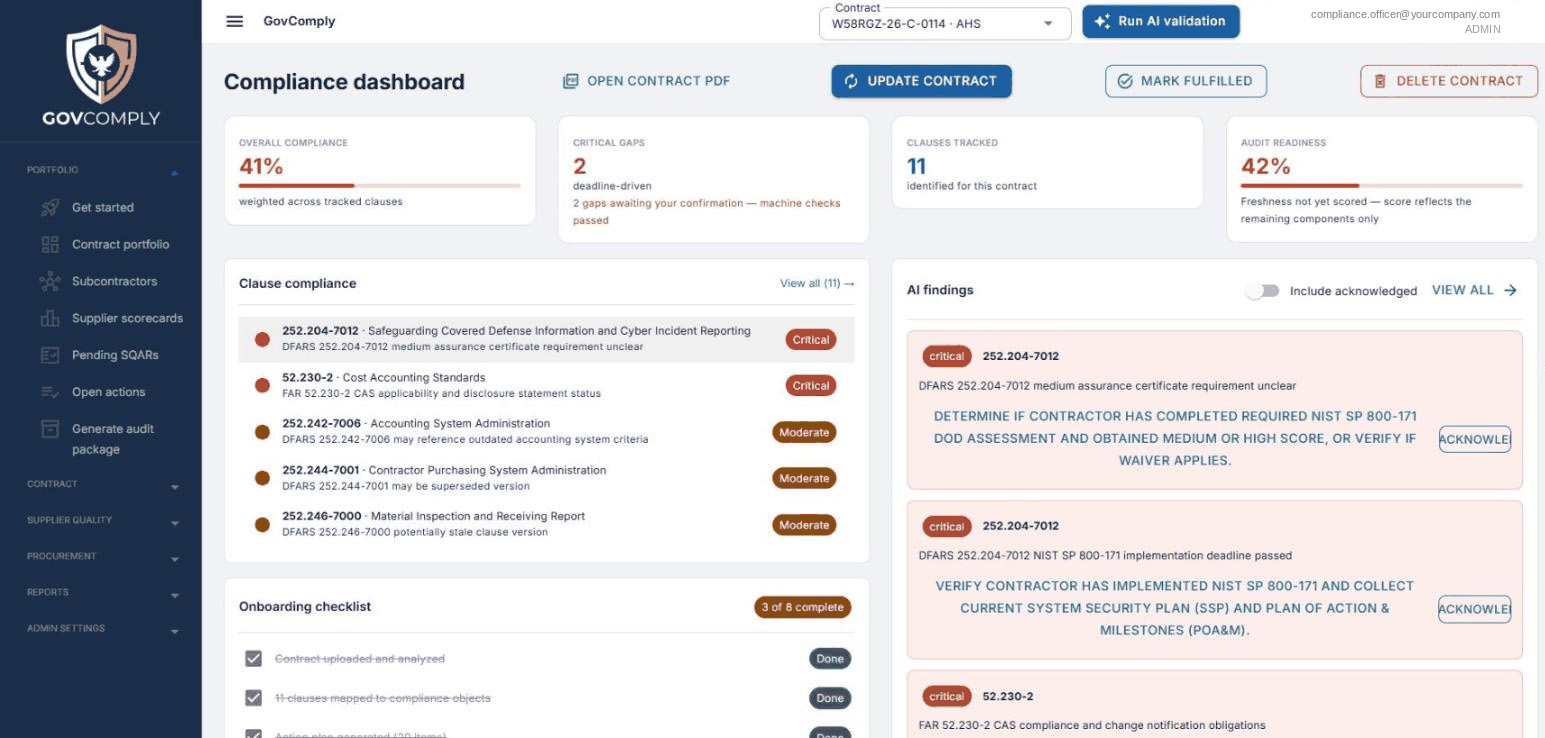
The same contract at a glance: overall compliance, deadline-driven critical gaps, clauses tracked and audit readiness, next to AI findings that name the specific remediation step rather than just flagging the clause.

Clause detail for DFARS 252.204-7012. The documentation the clause actually requires is spelled out in plain language, and every document linked to the clause is graded against that requirement instead of being counted as coverage.
Why this matters
A missed clause on day one of a new award does not stay small. It compounds for the life of the contract, and it is usually the first thing DCAA finds. The clause gap alert exists because reading a contract by hand and cross-referencing acquisition.gov manually is slow and inconsistent, even with an experienced compliance officer doing the reading.
How it works in GovComply
GovComply parses the contract the moment it is uploaded, identifies every FAR and DFARS clause present, and checks each one against the corresponding requirement on acquisition.gov. Anything you have not documented yet gets flagged with a severity level, so you know what to fix first instead of working through the list in whatever order it happens to appear.
Common questions
How does GovComply know what each clause requires?
Each FAR and DFARS clause is mapped to its compliance object on acquisition.gov, which is the authoritative source for clause text and requirements. GovComply checks that mapping against your existing documentation, not against a static internal database that can go stale.
What happens if a clause has no documentation requirement?
It is marked informational rather than a gap. Not every clause has an associated document you need to produce, and the system does not generate false work.
Can I see why a clause was flagged critical versus moderate?
Yes. Every flag includes the reasoning and a plain-language remediation note so a non-lawyer on your team can act on it without translation.
Explore the rest of GovComply
See how it works against a real contract.
Bring one of your active contracts to the demo. We'll run the analysis live.