
DFARS Clause Flowdown Enforcement
Automatically identify required DFARS flowdown clauses, build a per-subcontract matrix, and track subcontractor acknowledgment status.
DFARS Clause Flowdown Enforcement
Stop managing flowdown compliance in a spreadsheet that nobody keeps current.
Prime contractors with DFARS obligations flowing to subs typically manage this in Excel, updated inconsistently by subcontracts administrators. No system automatically identifies required flowdowns based on contract type and dollar thresholds. No system tracks whether subs have acknowledged required clauses. CPSR findings often trace back to exactly this gap.
GovComply's clause engine cross-references each DFARS clause in your prime contract against its flowdown applicability rules — mandatory, discretionary, threshold-triggered — and generates a subcontract flowdown matrix per subcontract. Acknowledgment status is tracked. Gaps are flagged as CPSR risk items before the auditor flags them first.
What you get
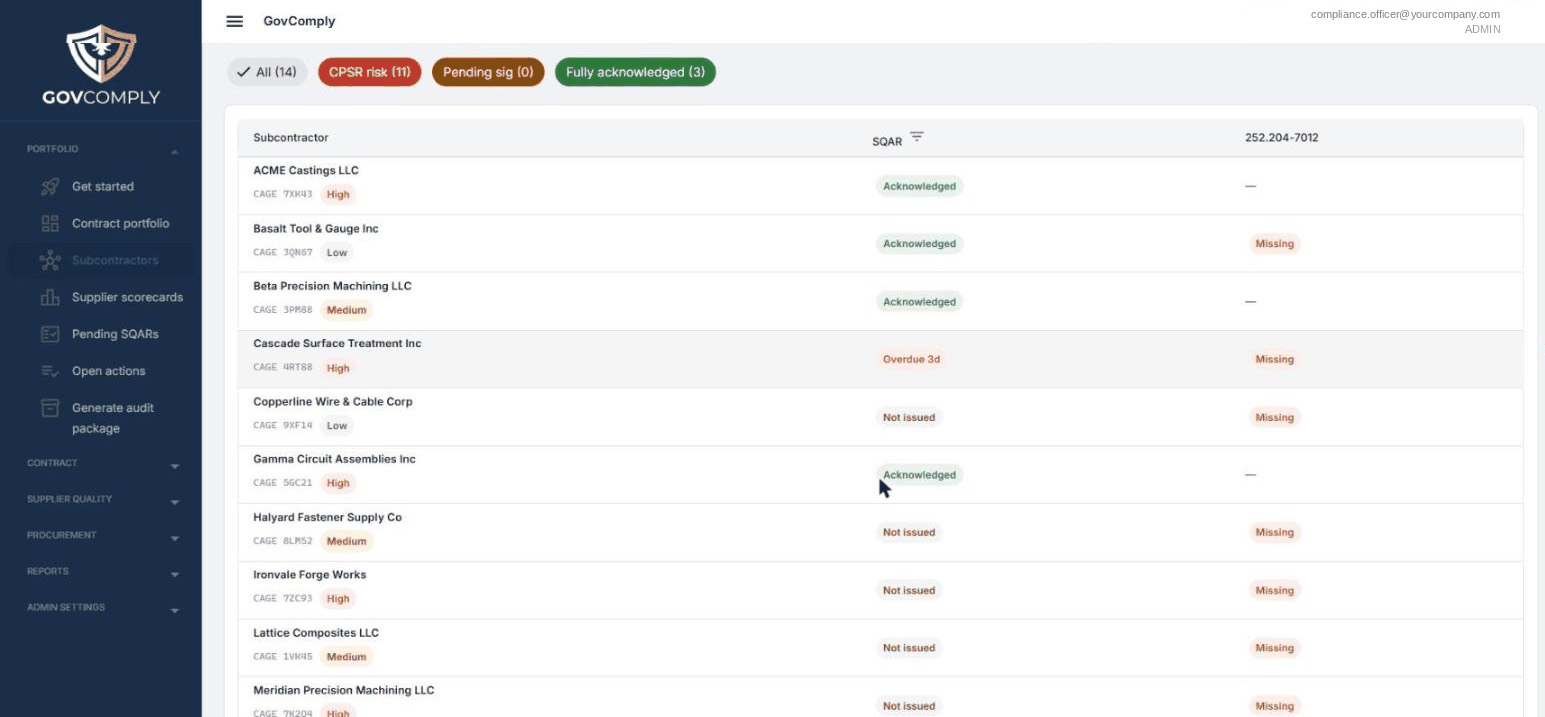
The flowdown matrix across 14 active subcontractors: acknowledgment status for each required clause on each sub, with supplier risk tier and CAGE code on every row, and a one-click filter for the subs currently carrying CPSR risk.
Live screenshot from the GovComply application. Tenant identifiers, account holder details and third-party supplier document names have been anonymized.
See flowdown enforcement in the product
These are screenshots of GovComply tracking flowdown across a live subcontractor base in a development tenant.
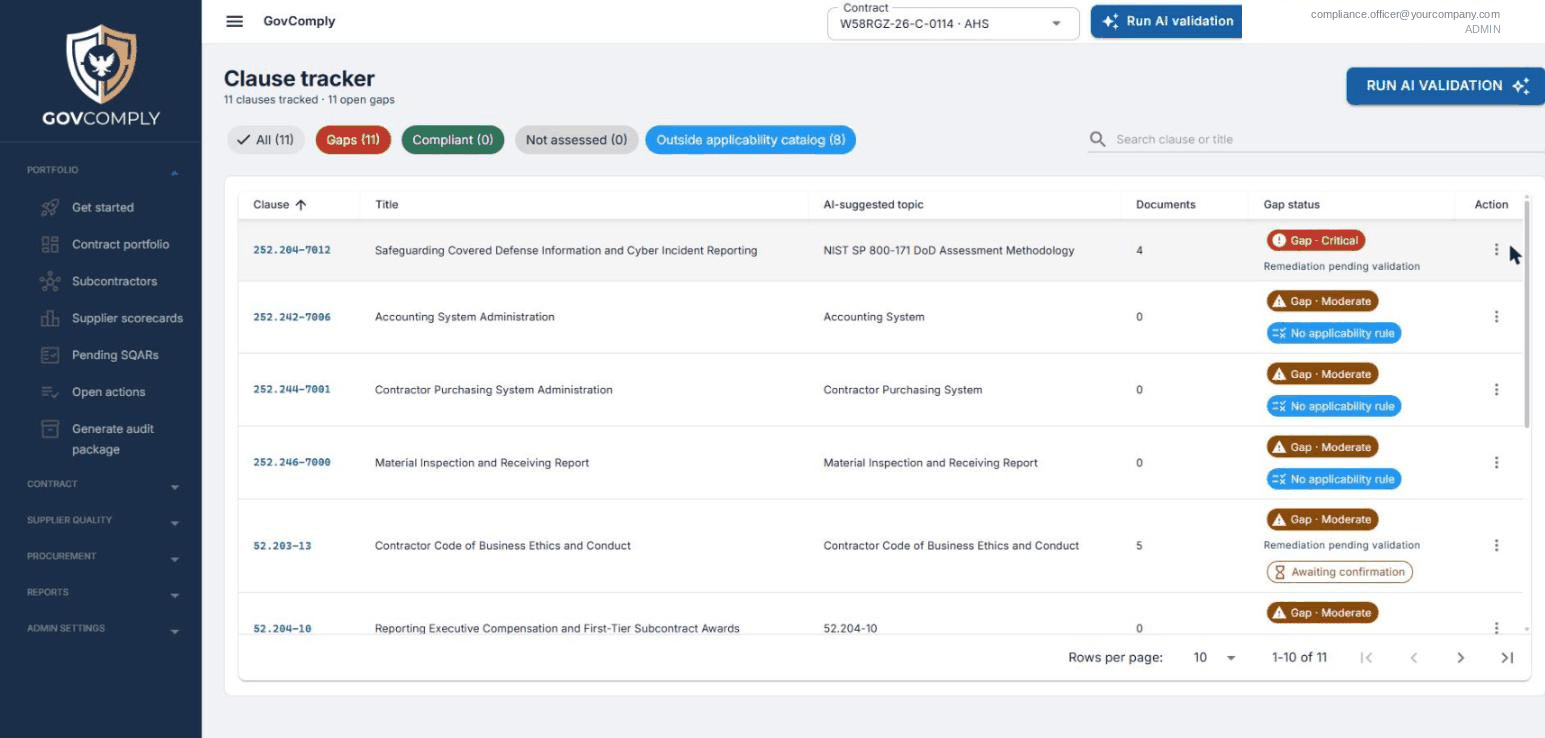
Flowdown starts from the prime contract clause set. Clauses with no applicability rule in the catalog yet are surfaced explicitly, so flowdown for them is decided deliberately rather than assumed.
Why this matters
Flowdown gaps are a recurring theme in CPSR findings, and the reason is almost always the same: it is tracked in a spreadsheet that one person updates when they remember to, with no system check on whether a clause actually applies or whether the sub has acknowledged it.
How it works in GovComply
GovComply cross-references every DFARS clause in your prime contract against flowdown applicability rules, mandatory, discretionary, and threshold-triggered, and builds a matrix per subcontract. Acknowledgment status is tracked against each clause, so a missing acknowledgment shows up as a flagged risk item well before an auditor would find it.
Common questions
How does GovComply determine threshold-triggered flowdowns?
Dollar thresholds and applicability rules are evaluated against your subcontract value and contract type, the same logic a subcontracts administrator would apply manually, just consistently and every time.
Can subs acknowledge clauses directly in the system?
Acknowledgment can be recorded with a document attachment per clause, giving you a record tied directly to the flowdown matrix rather than a separate email chain.
Does the flowdown matrix update if the prime contract is modified?
Yes. A contract modification that changes the clause set triggers a re-evaluation of the flowdown matrix for affected subcontracts.
Explore the rest of GovComply
See how it works against a real contract.
Bring one of your active contracts to the demo. We'll run the analysis live.